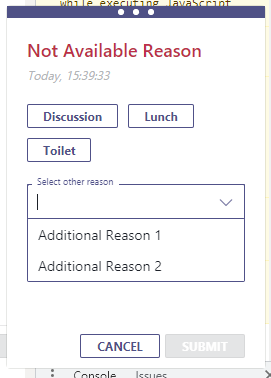
Not Available Reasons (NAR) are reasons that a user must specify when becoming unavailable to new Nimbus tasks (Not Ready). This can happen either through inactivity or when actively transitioning into MS Teams presence Away, Busy or DND. The reasoning must be provided via the Assistant app UI and is stored for Power BI as part of the Nimbus Reporting Model.
✅ Preconditions
Licensing:
- Contact Center: Note that a Contact Center license needs to be applied to the user (via User Administration or License Management). Doing so enables the “NAR" tab on the User Administration.
- Assistant - an Assistant license is required on the user in show a selection of Not Available Reasons assigned to the user. Assistant ensures that this request is made regardless of Nimbus is currently in focus or not.
Data Privacy and User Configuration:
GDPR As this Nimbus Feature concerns user privacy, the feature needs to be enabled by a Tenant Administrator first.
- Head to Tenant Administratiion > "Data Privacy" section and enable "Persist User States in Reporting".
⮑ Note that enabling this will allow Nimbus to keep a historic track record of User States in the Nimbus Reporting Model. - Optionally, in the same "Data Privacy" section, enable "Display Not Available Reasons on Tooltips".
⮑ Once enabled, the tooltips in Services Overview and Live View display the Not Available Reason a user selected in the Assistant. - Within Admin > Configuration locate the now enabled “Not Available Reasons” entry. Further steps are explained below.
☝️ Note: Not Available Reasons (NAR) are disabled during “Emergency Manual Presence Mode”
Situationally - when Emergency Manual Presence Mode is enabled in Extensions Tenant Settings: Not Available Reasons rely on the DND, Busy, and Away Microsoft Teams presence. During Emergency Manual Presence Mode, presence is steered via Nimbus instead of MS Teams. Users can only set themselves to Available or Appear Offline — there is no DND, Busy, or Away state to trigger a NAR prompt, so NAR does not apply while this mode is active. → Please inform your users when using this mode.
Creating Not Available Reasons (NAR)
- Log in to the Admin Portal with any Administrator Role with access to the configuration
- Head to Configuration > Not Available Reasons
- Create or Edit any of the existing Not Available Reasons.
-
Define a Name for the reason.
💡 This is also how it will appear for the users of Nimbus in other menus. -
Set an Organization Unit.
💡 Note that you can change the visibility of these reasons. Users will still get to select the reason until it is removed from their account in the User Administration. → See next step.

Applying NARs to Users
- In Admin Portal, head to the User Administration
- Select the user you want to edit. ✅ Reminder: Ensure that the user has a Contact Center license so the NAR tab is shown.
- Select the NAR tab.
- Enable “Not Available Reasons”
- Click "+Add" and provide at least one (or multiple) NAR for the user to pick from.
💡 You can re-order the entries via drag&drop to make sure the most important reasons are on top.

Usage of NARs
Once assigned to a user, a choice of reasons can be picked from (e.g. using the Assistant UI) as soon as Nimbus considers the User's presence state as “not ready (not selectable)" for tasks such as:
Source |
MS Teams Status |
☝️Notes for Admins and Service Owners |
|---|---|---|
| MS Teams Presence | DND |
While configuring and naming your NAR, consider Distribution Service Settings of each Service:
|
| Busy (see 🔀) | ||
| Away (see 🔀) |
Notes
🔎 NAR & Durations in BI Reporting
GDPR Power BI tracking of User States includes both NAR and the duration of (non-)availability. An non-availability period will start from the point a user changes to not available state until being either:
- ... back in an "Available" state.
- ... opting into an "Off Duty" type Responsibility Profile .
- ... going offline in MS Teams.
INC NAR NRR Comparison
🔍 COMPARISON: Not Available Reason (NAR) vs. Not Ready Reason (NRR)
NAR and NRR may sound alike, but each answers different questions.
- NAR - Not Available Reason, are user-picked from a pre-defined list of Not Available Reasons (NAR).
- NRR - Not Ready Reason, is automatically determined by Nimbus for the user, based on their User State.
- Tenant Admins can configure if these reasons are tracked in Nimbus reporting, or be exposed to the Nimbus UI.
Learn more…
| Criteria | Not Available Reason (NAR) | Not Ready Reason (NRR) |
|---|---|---|
| Trigger Point | The user manually picks a reason in the Nimbus Assistant app when their Microsoft Teams presence changes to Away, Busy, or Do Not Disturb (after a period of inactivity or manual presence change in MS Teams). | Nimbus calculates the reason automatically whenever a user's presence, duty state, or task activity makes them Not Ready. No action from the user is required. |
| When to Use | Used to capture a business reason for a user's non-availability (for example "In a meeting" or "On a break") for later reporting. | Always on once enabled. Use it to see, at a glance, why Nimbus considers a user Not Ready, without waiting on the user to respond. |
| Where Shown in UI |
💡Not Available Reasons (NAR) provided and assigned per user. Shown by default in Nimbus Assistant UI prompts. ✅ Optional Admin setting: Can also be surfaced with the Tenant Data Privacy Setting > "Display Not Available Reasons on Tooltips" ⮑ When enabled:
|
💡Not shown by default.. Automatically generated and shown once enabled.
✅ Optional Admin setting: Can be surfaced with the Tenant Data Privacy Setting > "Display Not Ready Reasons on Tooltips" ⮑ When enabled:
|
| Tracked in Reporting |
✅Optional: Only if Tenant Data Privacy Setting > "Persist User States in Reporting" is enabled. ⮑ When enabled: In historical Nimbus Reporting as part of the Nimbus Reporting Model > Slowly Changing Dimensions > |
✅Optional: Only if Tenant Data Privacy Setting > "Persist User States in Reporting" is enabled. ⮑ When enabled: In historical Nimbus Reporting as part of the Nimbus Reporting Model > Slowly Changing Dimensions > |