 Distribution Priority
| Description |
This activity overrides the default "Task Priority" – by Default: Normal – configured in your within Distribution Service Settings > Task Priority section. Note: Flow Actions used in the Nimbus Power Automate Connector can also impact the “Task Priority” of an existing task, effectively overriding both default service settings and your workflow. |
||||||
| Required Predecessor | Accept | ||||||
| License |
|
||||||
| Modalities | Audio / Video | Instant Messaging | External Task | ||||
Common Properties
| Configurable Property | Task Priority | Behavior |
| Priority | |
|
💡 When to select "Strict" or "Nothing Else" as priority?
Set "Strict" when tasks need to be put on top of your queue.
|
Set "Nothing Else" when tasks should only get distributed when your service queue is empty.
|
| ✅ Use this for emergency services and important VIP hotlines that always should get precedence over anything else in the task queue. | ✅ Use this for non-time-sensitive tasks in when your maximum queue time is long enough for them to get handled eventually. |
| ☝Other tasks can get lost due to potentially long queue times as new incoming “Strict” tasks always take precedence. | ☝ These tasks can get lost due to all other tasks taking precedence. |
🔎 Notes: Priority in other Nimbus areas
-
Nimbus Power Automate Connector: Whenever workflow-related Trigger Event criteria are met, Flow Actions can also be used to set a task priority dynamically.
☝️ This new value will override the default priority set in the Distribution Service Settings. -
Distribution Priority steers “WHEN" a task enters a queue, not the target itself. A service's Distribution Policy steers “WHO”. (e.g. among "Longest Idle" or "Most qualified") Nimbus users gets the task.
💡 In a skill-based service distribution this can mean that even high or strict priority tasks may not get handled, if there is no Agent available to handle this task. -
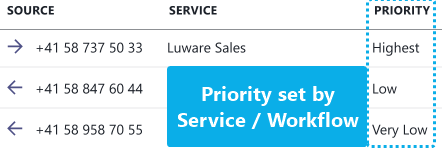
Task widgets (e.g. My Overview or Personal Dashboards) have a "Priority" column which indicates how high this task is ranked in the overall queue.
💡 A priority change may "displace" existing tasks to a new rank.
Weighted Round Robin Task Distribution
Due to priority-influencing factors mentioned above, tasks may starve long enough to drop out of your queue. An example would be a "Lowest" priority task getting outranked by a huge or stead inflow of higher priority tasks.
To avoid this, a weighted round robin method is in place to mix in lower-priority tasks, which are equally distributed amongst available users.
Learn more about the weighted round-robin method
The Round Robin procedure distributes the calls in such a way that the ratio between the individual priority levels is always 2:1. Each time another "Round" is started, that round counter is applied to the "weight" of the remaining tasks.
The following example table assumes a configuration with 3 priority levels. There are 21 calls in the queue, with the following priority:
- 12 calls with priority 1
- 6 calls with priority 2
- 3 calls with priority 3
Following the 2:1 rule, the calls are queue over time t as follows:
- Round 1: High Med tasks added in 2:1 ratio. No "Low" priority tasks in Round 1 as "Medium" task count outweighs the low task count.
- Round 2: High Med Low tasks added in 2:1 ratio. The "Low" priority tasks get a round-multiplier added to their weight, now outweighing "Medium" tasks and thus are added in a 2:1 ratio.
- Round 3: Same as Round 1.
🔍 Sources: Weighted Round Robin (Wikipedia Article). Please note that this example only works as long as no new calls are being processed. Calls with strict or no priority are not considered in this rule.
Legend: Q: Calls in Queue | H: Handled | R: Remaining
| Priority | Q | H | R | H | R | H | R | H | R | H | R | H | R | H | R | H | R | H | R | H | R | H | R | H | R | H | R | H | R | H | R |
|---|---|---|---|---|---|---|---|---|---|---|---|---|---|---|---|---|---|---|---|---|---|---|---|---|---|---|---|---|---|---|---|
| 1 (high) | 12 | 2 | 10 | 2 | 8 | 2 | 6 | 2 | 4 | 2 | 2 | 2 | 0 | ||||||||||||||||||
| 2 (med) | 6 | 1 | 5 | 1 | 4 | 1 | 3 | 1 | 2 | 1 | 1 | 1 | 0 | ||||||||||||||||||
| 3 (low) | 3 | 1 | 2 | 1 | 1 | 1 | 0 | ||||||||||||||||||||||||
| Round Counter | Round 1 | Round 2 | Round 3 | Round 4 | Round 5 | Round 6 | |||||||||||||||||||||||||
| Time (t) | t1 | tn | |||||||||||||||||||||||||||||
☝ Reminder: Tasks in a queue with either "Strict" or "Nothing Else" priority will ignore round-robin distribution.
Audio / Video
No specific behaviors for this modality. “Common Properties” apply.
Instant Messaging
No specific behaviors for this modality. “Common Properties” apply.
No specific behaviors for this modality. “Common Properties” apply.
External Task
No specific behaviors for this modality. “Common Properties” apply.