Nimbus is a Luware cloud-based solution that integrates seamlessly with Microsoft Teams to act as a customer communication service application. From intelligent routing of company numbers, efficient call transfers, distributed call routing to teams, up to building complex contact centers – Nimbus hears your call to action. Nimbus can be configured for various Service Types according to your own choice.
Nimbus key features
💡Links below lead to further pages in the Knowledge Base.
| Integrated into Microsoft Teams and Azure |
|
|---|---|
| Quick to onboard |
|
| Lean and distraction-free |
|
| Flexible call handling |
|
| Transparent |
|
Nimbus service types
Service Types
🔀 Note: The concept of “Service Types” (on this page) has been split apart from service licensing. A new page has been created to explain License Types.
INC Service Types
🔎 The Service Type determines how the Service connects to Microsoft infrastructure. In extension, this defines which features and settings the service offers. The following Service Types are defined in the Nimbus:
| Service Type (column value) |
What it is | How it is created | License Management |
|---|---|---|---|
| Nimbus Extend | An Integration Model: the Service is based on Microsoft Teams and Microsoft Graph. |
By an administrator in Service Administration (→ Create Service). Can also be created from MS Teams channels as described by Service Provisioning) |
✅ Licensed per Service |
| Nimbus Unify | An Integration Model: the Service is based on Microsoft Teams Phone Extensibility and Azure Communication Services, used with Luware NimbusOne. | By an administrator in Service Administration (→ Create Service), choosing Nimbus Unify. Available once Nimbus Unify is enabled for the tenant. | ✅ Licensed per Service |
| Direct Call | A personal (→ Direct Call Handling) Service that handles the direct calls of one user. | Per user, from the user’s Direct Call tab in User Administration. |
✅ Licensed per User Nimbus automatically creates a personal Direct Call Service for each licensed user. Does not consume a regular service license. |
💡The service type is displayed in the Service Type column of the Services list in Service Administration.
What the Service Type controls
The Service Type is chosen when a Service is created. From then on it mainly decides which Service Settings tabs and options are available. Options that a Service Type does not support are not shown at all.
💡 Important to note: Service Types are chosen at creation of a Service. As this choice determines how the Service communicates at the Nimbus / Microsoft infrastructure layer and connects users, it cannot be changed afterwards.
💡 Good to know: The Service Type column is only shown in the Services list when “Nimbus Unify” is enabled for your tenant. Without it, all standard Services are automatically created as “Nimbus Extend” Services.
Service Types and Workflows
Workflows are tied to a Service Type as well. When you create a Workflow, a Service Type selection (Nimbus Extend, Nimbus Unify or Direct Call) is offered as soon as Nimbus Unify or Direct Call Handling is enabled for your tenant. The Audio/Video Workflow selection in a Service’s Modalities settings then only offers Workflows of the matching type. This happens mostly invisible to the service-owning user, but is still worth noting, as Workflow Activities use identical naming, but may differ slightly in their behavior and available properties.
Service Types and Settings
Service Settings are significantly impacted by the chosen Service Type. While the general Settings tabs structure remains identical, the service type will determine which detail properties, toggles and fields are there to configure. For the configuring administrator this is primarily noticeable by licensing options and tab details mismatching between services of different type.
💡 Good to know: Service Types and Bulk Editing: When an Administrator selects several Services to bulk edit, only Services of the same Service Type can be selected together. With this method, Nimbus prevents any accidental misconfiguration of mismatching features along services.
Nimbus Extend and Nimbus Unify
Nimbus Extend and Nimbus Unify are the two Integration Models for standard Nimbus Service types. You choose one when you create a Service. Nimbus uses the Service Type (and follow-up Integration Model choice) to connect to the Microsoft phone ecosystem. In a nutshell:
- Nimbus Extend – based on Microsoft Teams and Microsoft Graph. This is the known Nimbus UI Service experience known by most customers, designed to natively integrate within Microsoft Teams.
- Nimbus Unify – based on Microsoft Teams Phone Extensibility and Azure Communication Services. This is a new experience, using Luware NimbusOne as the central client, designed to work independently form Microsoft Teams.

💡 Good to know: Regardless of the Service Type & Integration used, the configuration remains in Nimbus. However, note that the integration method has repercussions for how customer journeys are orchestrated, how AI capabilities can be applied, how reporting is generated, and how closely the platform aligns with the Microsoft ecosystem.
🔎 Below is an excerpt of Integration Model Comparison.
Nimbus Extend
Nimbus Extend
Nimbus Extend – in the following called just “Extend” – is one of the two Microsoft Teams contact center integrations of Luware Nimbus. It is built for organizations that follow a Microsoft Teams-first strategy: Microsoft Teams stays the primary workspace, and Nimbus adds customer engagement capabilities to it.
Extend does not replace the Microsoft Teams client and it does not introduce a separate agent application. It adds service routing, queueing, workflow orchestration, callback handling, reporting, dashboards, automation and AI-assisted capabilities to the Teams environment your users already work in.
How does it work?
How Extend works
Extend is the Microsoft Graph-based communication integration model of Nimbus. Microsoft Graph provides the integration foundation: through Graph-based communication and collaboration integration, Nimbus aligns customer engagement workflows with Microsoft Teams users, Teams context, presence information and related Microsoft 365 services.
The result is a single workspace experience. Collaboration communication (meetings, chats, internal calls) and customer engagement communication (queued interactions, transfers, service workflows) are both handled in Microsoft Teams, while Nimbus orchestrates the customer engagement side behind it.
| Architectural aspect | Extend |
|---|---|
| Microsoft foundation | Microsoft Teams and Microsoft Graph |
| Communication integration model | Microsoft Graph-based communication integration |
| Primary user experience | Microsoft Teams |
| Strategic positioning | Organizations with a Microsoft Teams-first strategy |
| Operational philosophy | Customer engagement as an extension of the Teams workspace |
| Nimbus responsibility | CX orchestration, service routing, workflow automation, reporting, automation and AI capabilities |
What are the benefits?
Benefits of Extend
Extend keeps the customer engagement capabilities that users already know.
➕ Maximum alignment with Microsoft Teams. Teams adoption, governance models and user familiarity are preserved end to end.
➕ Low adoption barrier. Users keep working in the client they already use every day — there is no second application to learn, roll out or support.
➕ Collaboration and customer engagement stay connected. An agent can escalate to a colleague, start a chat or pull in an expert without leaving the workspace the interaction lives in.
➕ One workspace to manage. Device management, client deployment and endpoint policies remain a Microsoft Teams concern.
➕ Microsoft 365 context out of the box. Teams users, Teams context, presence and related Microsoft 365 services are available to customer engagement workflows through Microsoft Graph.
➕ Full Nimbus CX orchestration. Services, routing, queueing, workflows, callbacks, dashboards, automation and AI-assisted capabilities all apply.
➕ No platform trade-off. Extend uses the same reporting model, administration model and governance framework as Nimbus Unify.
Who is Extend for?
When to choose Extend
Extend is the choice for if Microsoft Teams remains the primary workspace.
✔️ Microsoft Teams is your employee workspace and should stay that way for customer-facing users too.
✔️ Customer engagement and internal collaboration are closely intertwined — service teams, expert lines, back-office and hybrid roles that both collaborate and take customer interactions.
✔️ Teams governance, compliance and device management models are already established and should also cover customer engagement.
✔️ Rolling out and supporting a second client would add more friction than adjusting your existing MS Teams workspace.
Nimbus Unify
Nimbus Unify
Nimbus Unify – in the following called just “Unify” – is one of the two Microsoft contact center integration models of Luware Nimbus. It separates the communications foundation from the user experience layer: Microsoft Teams Phone remains the communications foundation, while customer engagement users work in the workspace best suited to their job.
Unify does not introduce a separate telephony platform. It extends Microsoft Teams Phone through Microsoft Teams Phone Extensibility (TPE) and Azure Communication Services (ACS), so that dedicated customer engagement workspaces, CRM-embedded communication and real-time AI scenarios become possible on the same Microsoft communications foundation.
How does it work?
How Unify works
In the Unify model, Teams Phone Extensibility and Azure Communication Services provide the communication extensibility layer. Nimbus provides service routing, workflow orchestration, reporting, dashboards, automation and AI-assisted capabilities on top.
| Architectural aspect | Unify |
|---|---|
| Microsoft foundation | Microsoft Teams Phone Extensibility and Azure Communication Services |
| Communication platform | Microsoft Teams Phone |
| Communication integration model | Teams Phone Extensibility with Azure Communication Services |
| Primary user experience | NimbusOne, CRM CTI, dedicated engagement workspaces, and Microsoft Teams in selected scenarios |
| Strategic positioning | Organizations requiring dedicated customer engagement workspaces, high-volume interaction handling, CRM-centric workflows or real-time AI scenarios |
| Operational philosophy | Customer engagement as a dedicated operational discipline |
| Nimbus responsibility | CX orchestration, service routing, workflow automation, reporting, AI, Client-of-Choice experiences and governance |
Teams Phone Extensibility
Teams Phone Extensibility is a Microsoft architecture foundation which allows customer engagement application to integrate with Teams Phone through Azure Communication Services.
| Capability enabled by Teams Phone Extensibility | What it means for Nimbus |
|---|---|
| Dedicated customer engagement clients | Enables NimbusOne and further specialized customer engagement experiences |
| Media access through Azure Communication Services | Supports transcription, speech processing and AI scenarios1. |
| Separation of communications foundation and client experience | Enables the Client-of-Choice architecture |
| Microsoft Teams Phone alignment | Keeps the communications foundation Microsoft-native |
| Advanced contact center scenarios | Supports professional contact center operations, CRM-centric workflows and high volumes |
Because Azure Communication Services is part of the communication architecture, AI can operate close to the communication stream instead of as delayed post-processing. This is what makes real-time transcription, speech-to-text, text-to-speech, live AI assistance, AI voice agents and conversation intelligence possible.
1🔎 Also see: Transcription and Summarization feature pages as well as Nimbus Virtual Users and related Best Practices - Virtual Users in Nimbus.
Which client do users work in?
Client-of-Choice
With Nimbus Extend the communication architecture and user experience architecture were tightly coupled: if the communication platform was Microsoft Teams, the user experience had to be in Teams as well.
Unify breaks that coupling: Client choice changes the interaction surface, not the platform model. Different user groups can work in the environment that suits their daily responsibilities, because all clients operate on the same platform — the same services, workflows, users, Responsibility Profiles, tasks, Unified Sessions, reporting projections, integrations and security controls.
| Client experience | Typical role | Value |
|---|---|---|
| NimbusOne | Contact center agents and supervisors | For users that want a optimized and customizable unified agent desktop for their customer communication — See Luware NimbusOne.1 |
| Salesforce CTI | Sales and account teams | For users and services whose primary use cases are handled in a third-party CRM or ERP |
| Dynamics CTI | Service and customer operations teams | Embeds communication into Dynamics-based business processes |
| Microsoft Teams | Teams-first users and collaboration-centric service teams | For users and services whose primary use cases are handled in a third-party CRM or ERP — see the Nimbus Teams Tab |
| Further clients | Specialized customer engagement scenarios | Extends the platform without changing routing, reporting or governance |
1💡 NimbusOne as a Nimbus Unify client
Luware NimbusOne is a customizable customer engagement workspace for Nimbus. It is not a separate platform and it does not replace Nimbus — but can replace Microsoft Teams as one of the possible clients that access the Nimbus platform through the Unify architecture. Because it is purpose-built for customer engagement rather than collaboration, it can prioritize call handling efficiency, customer context, queue awareness, AI assistance, transfer workflows and supervisor visibility.
How are collaboration and customer engagement separated?
The Microsoft Dual Persona operating model
Most users participate in two fundamentally different communication contexts:
- Internal collaboration communication — meetings, chats, peer-to-peer calls, ad-hoc teamwork — is optimized for flexibility.
- Customer engagement communication — queued interactions, service-level objectives, customer context, transfers, escalation workflows, CRM updates and high call volumes — is optimized for speed, service quality, routing efficiency and operational control.
Unify lets these two personas be separated: personal and internal collaboration communication continues through Microsoft Teams, while customer engagement communication is handled in a dedicated experience. Contact center interactions and personal Teams calls no longer disrupt each other.
| Persona | Primary communication context | Typical workspace | Objective |
|---|---|---|---|
| Collaboration persona | Internal meetings, calls, chat and teamwork | Microsoft Teams | Preserve the Microsoft collaboration experience |
| Customer engagement persona | Queued customer interactions, routing, transfers, customer context and service workflows | NimbusOne, CRM CTI or another dedicated client | Optimize customer engagement efficiency and operational focus |
A user handling several hundred customer interactions per day does not have the same workspace requirements as a user who mainly works in meetings and chats. In high-volume environments every additional click, context switch or workspace interruption affects handling speed, customer experience and operational efficiency.
What are the benefits?
Benefits of Unify
Unify gives customer engagement users a workspace built for their job, without leaving the Microsoft communications foundation.
➕ Communications foundation and user experience are decoupled. Microsoft Teams Phone stays the communication platform, and you still choose the best workspace per role.
➕ Client-of-Choice. Agents in Luware NimbusOne, sales users in Salesforce, service users in Dynamics 365, knowledge workers in Microsoft Teams — all on one routing and one reporting model.
➕ Optimized for high volume. A dedicated workspace removes the clicks, context switches and interruptions that cost handling time when users take hundreds of interactions per day.
➕ Dual Persona separation. Contact center interactions stay separate from personal Teams calls, so neither context disrupts the other.
➕ Native real-time media access. Azure Communication Services makes the media stream available for real-time transcription, speech-to-text, text-to-speech and conversation intelligence — AI acts during the conversation, not after it.
➕ CRM-embedded communication as a first-class pattern. Users work where their business process already lives.
➕ No platform trade-off. Unify uses the same reporting model, administration model and governance framework as Nimbus Extend, and new client experiences can be added without changing routing, reporting or governance.
Who is Unify for?
When to choose Unify
Unify is the choice for organizations with high-volume interactions that need dedicated customer engagement experiences, CRM-centric workflows or advanced real-time AI. while Microsoft Teams Phone stays the communications foundation.
✔️ Customer engagement work is high-volume, time-sensitive or strongly process-driven.
✔️ Microsoft Teams should remain the strategic collaboration platform, but is not the most efficient primary workspace for your customer-facing users.
✔️ Sales or service users need communication embedded in Salesforce or Dynamics 365 rather than in a separate client.
✔️ Real-time AI, live transcription or conversation intelligence are core requirements rather than nice-to-haves.
✔️ Different user groups have genuinely different workspace needs and should not be forced into one interface.
Direct Call
Direct Call is the Service Type of a Direct Call Handling Service. Unlike Nimbus Extend and Nimbus Unify it does not describe an Integration Model, but a Service that belongs to a user: it handles the calls made directly to that user, instead of calls to a shared team Service.
🔎 Note: “Direct Call” is also listed under the Service Types to signal that it has differences in how Service Settings are structured and Users are provisioned. This is made apparent as follows:
- Created per user: A “Direct Call” Type Service is set up from the user’s Direct Call tab in User Administration, not through Create New in the Services list. Optionally, each user can have one Direct Call Service in addition to regular service participation.
- Reduced Service Settings complexity: Options that make no sense for a single-user Service, for example the Service license, the Distribution Policy and presence-based distribution, are not shown (→ What the Service Type controls above).
- Own Workflows: Workflows that handle Direct Calls are also created with the Service Type Direct Call.
- Specific Preferences: The Extensions tab offers the specific settings only for this Service Type and there are additional Direct Call User Settings.
🔎 Also see: Direct Call Handling for the feature, and Direct Call User Settings for the per-user configuration.
The UI - all you need, one click away
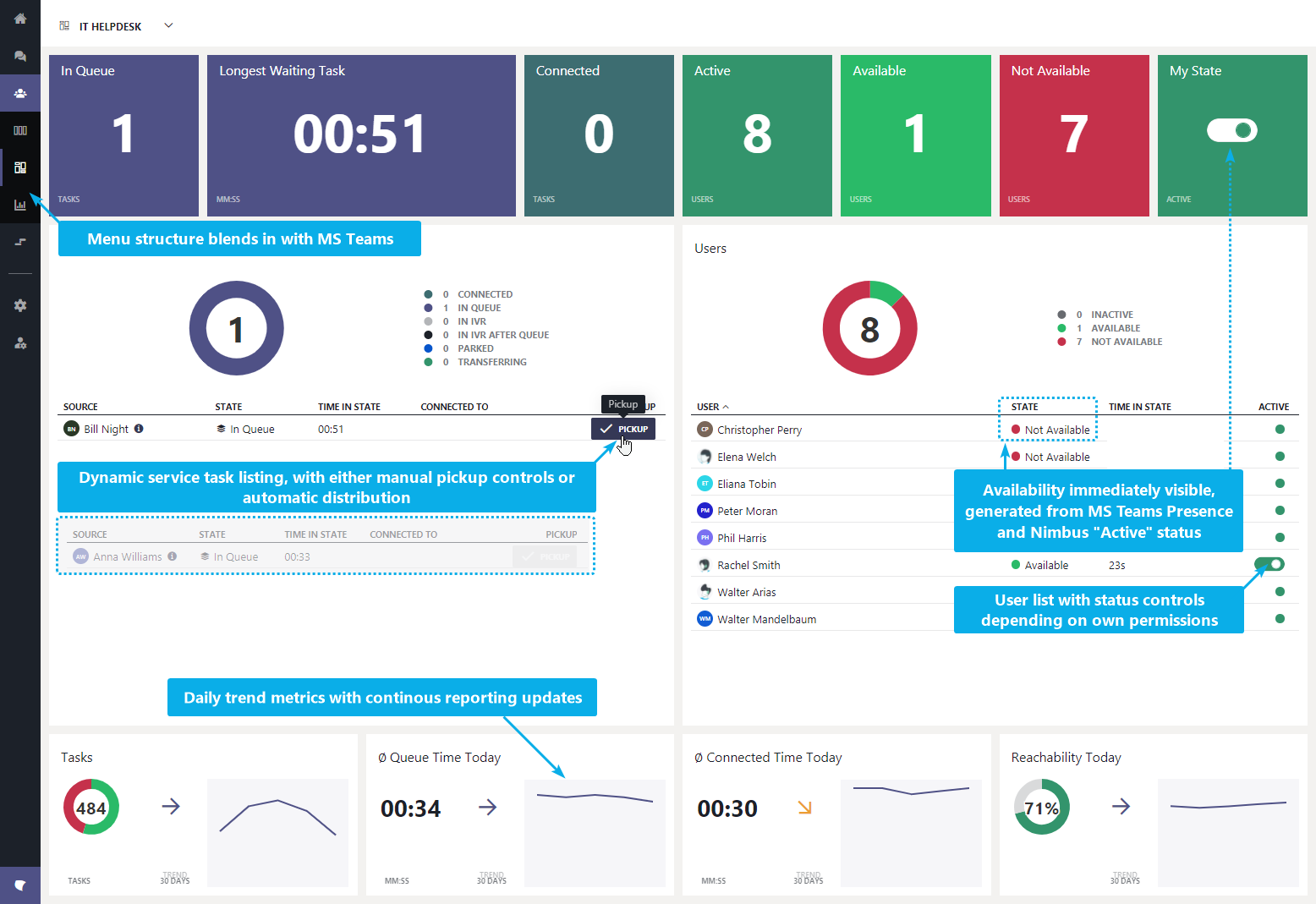
During a busy day, the Dashboard is there to access everything your team needs. Handle incoming calls, monitor KPI, manage team member availability – everything is one click away. The User Interface of Nimbus is designed to keep learning efforts and click-depth to a minimum.
Optional: Attendant Console integration
Nimbus integrates with Attendant Console, our one-click call transfer solution.
- Attendant Console is integrated into Teams client and available on all devices, e.g. Chrome Books
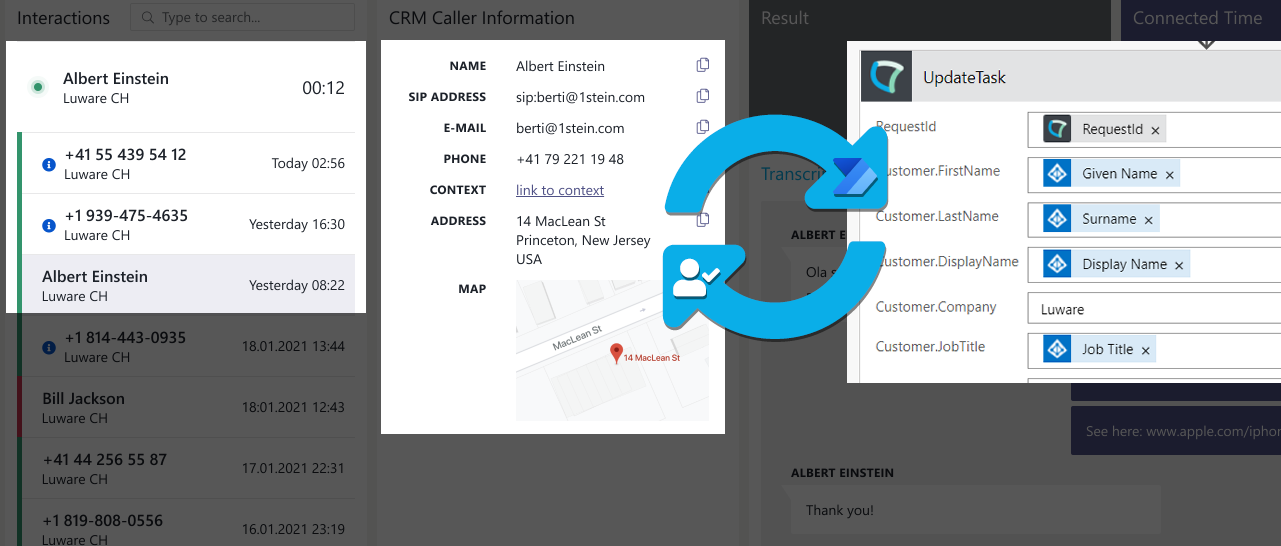
- Attendant Console provides a detailed queue with waiting time and caller ID (using MS Flow)
- You can pick specific calls from the Nimbus queue
- Attendant Console can be easily activated as an add-on to Nimbus
🔍 Head over to our official Luware Attendant product page to learn more.
Optional: Interact integration
Luware Interact is a solution that incorporates chat, voice and video calls directly into a website without any plugins. Users of Nimbus receive the customer interactions directly in their Teams client. From a customer perspective, the Interact UI is very simple to use, directly embedded as a code-snippet on a website. The customer engages on a simple setup process and starts talking directly with any user of Nimbus within their Teams client.
Interact currently supports the following modalities bi-directional and without any further browser installation requirements:
- Chat
- Voice
- Video
- Screen sharing
|
1.) An Interact customer starts the process 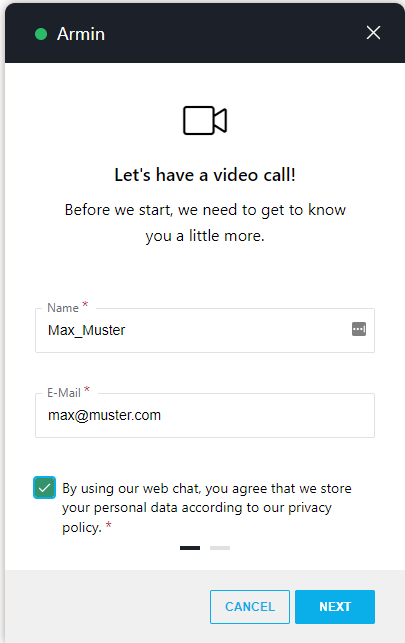
|
2.) A Nimbus user is anwering the call and sharing their screen directly with the customer 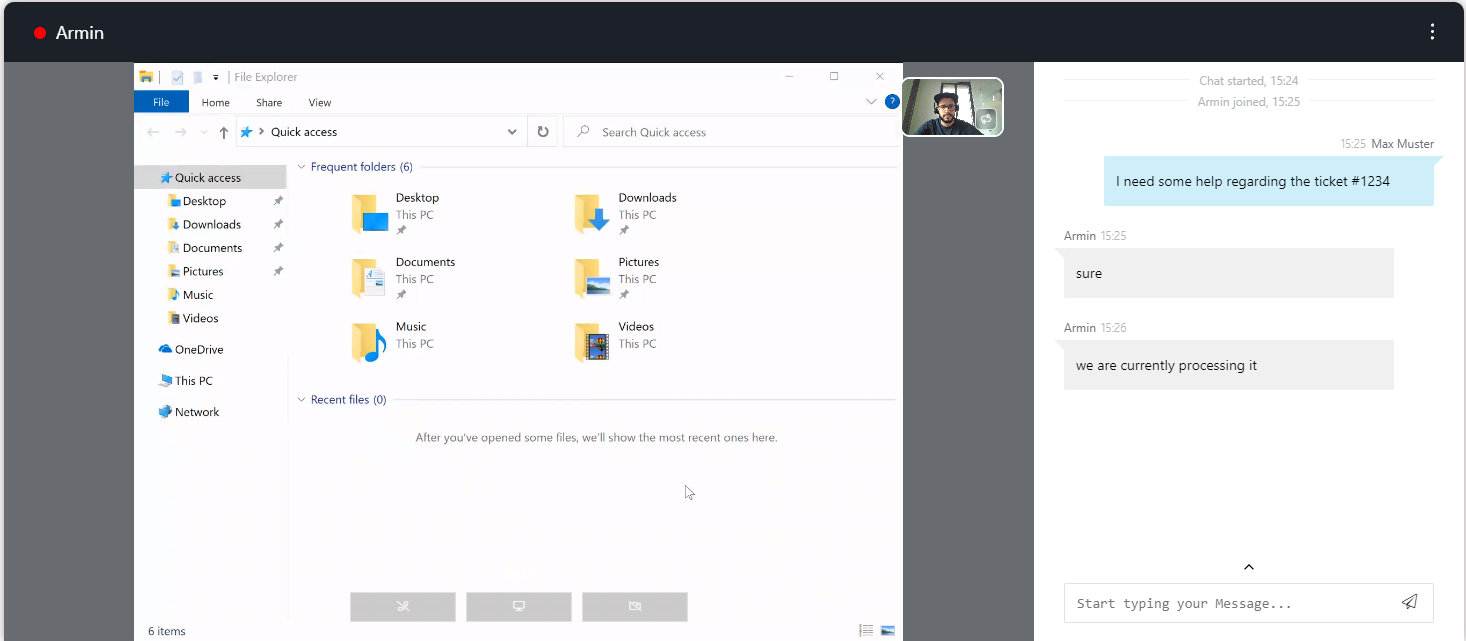
|
Good to know
- Nimbus Interact is a separately licensed Nimbus Feature and can be enabled individually for users and services. Please get in touch with a Customer Success partner as prior setup is required and technical limitations apply.
- The Interact configuration is done completely within the Administration. Also refer to Use Case - Setting up Interact for detailed steps.
- Customers from outside will directly interact with Nimbus users and servcies via website widgets. The website whitelist and the embed code are configured via Interact Domain Templates (CORS).
Info
🔍Head over to our official Luware Interact product page to learn more about Interact.
Power Automate / Flow Connector
Nimbus can be easily integrated with other applications (e.g. CRM, Ticketing, Databases) by using the Nimbus Power Automate Connector. Some possible use cases could be:
- A simple notification: Retrieve Nimbus task → Task gets lost → Trigger an email
- Live-Data exchange during calls: On updated Nimbus task → Retrieve caller info → Request task details from your CRM or user directory → Update the Task details
- Call-routing according to lists and parameters: e.g. VIP or blacklist handling of calls based on whitelists/blacklists you keep within your service team